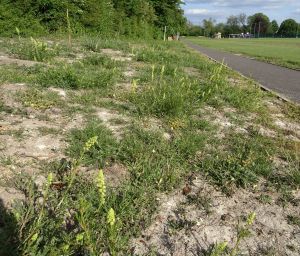
Elegant spikes of mignonette flourish at the Rec

Yellow spikes of wild mignonette flowering at the Rec
Tiny flowers of field madder, each smaller than a 5p piece.

Nearly exactly a month ago I was delighted to find the tiny lilac-purple flowers of field madder on the bareish bank, to the north east side of the Recreation Ground. But there is no missing the tall yellow spikes of the gloriously named ‘wild mignonette’ now out in flower along the same bank. These are wild flowers dressed to go to a ball… and our insects love them!

Flowering spike of wild mignonette

Apart from the joy of the plants themselves, wild flowers tell us about the makeup of the underlying soil. Only certain species grow on particular soils. As all those of you who are gardeners know, one of the commonest failures in gardening is to put plants in that do not suit the local soil – they do not grow well! So to with wild flowers – different areas of the country, or even different lanes within the same village, have different wild flowers according to the underlying soil and climate. So, wild mignonette can be seen growing along road verges and on edges of cultivated land all around the chalky land of the Brecks, to the north of Burwell.
Pasque flowers grow on chalky soils, including on Devil’s Dyke

These flowers become part of the culture of the area – as reflected in the naming of a county flower. For Cambridgeshire people voted for pasque flower, which we are lucky to have growing near us along the chalky Devil’s Dyke. (Devon’s county flower is primrose, which would not enjoy Devils’ Dyke’s chalky soil at all!)

Wild mignonette, is growing at the Rec because this species has adapted to thrive on chalky soil. The whole ecosystem at the Rec is built round this chalky under-surface with the insects, including moths and butterflies, that depend on plants for their food, ones that feed off these specialist chalk loving plants. Each individual flower looks slightly scruffy, it wouldn’t make a Chelsea Flower Show Gold – but it does its job.

I am going this afternoon to see how many different insects I can find feeding on one plant. Lets have a competition: let me know how many insects, and different species of insects you find on one clump of wild mignonette. I will publish the results in a future post… the person with the most will win a hand lens!

Subscribe to my blog.

Enter your email address and click Subscribe to follow this blog.
You’ll get an email each time I add another post.


This work is licensed under a Creative Commons Attribution-ShareAlike 4.0 International License.

Greenfinches squeak like an unoiled wheelbarrow

Greenfinches song includes an extended wheeze which sounds remarkably like a squeaky wheelbarrow wheel.

Like chaffinches, greenfinches are nesting now, holding onto their territories with a mix of calls and song, the most distinctive of which sounds like the drawn out squeak of an unoiled wheelbarrow wheel. I know as, until recently, each time I set off for the allotment with the wheelbarrow loaded with tools, I would be accompanied by a teeth jarring extended squeal and remember that once again I had forgotten to oil the wheel. Yesterday, I eventually got out the WD40 and a job of seconds was done!

I regularly hear this squeak, or wheeze as I walk round the Castle Mound; greenfinches love the thick hedges adjacent to the fields. While it sounds quiet on the recording above, the sound is really quite loud and distinctive. Greenfinches can also make a sound like a quiet version of a pneumatic drill: a rapid thud, thud, thud. This recording of a bird in Spain combines the wheeze and the thud. While any equivalences of sound require a bit of imagination, I find they help a lot when learning to pick out new bird songs.

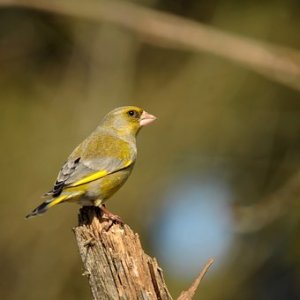
Male greenfinch, with chunky bill and yellow wing and tail edges. Photo thanks to pixabay.

I don’t often see the greenfinches themselves, but I am glad to know they are there. Do they come to your bird feeder? Occasionally they come to ours. Look out for their greenish bodies, and yellow wing edges. As with the chaffinch, the females are drabber – more brown than green, with a thinner yellow wing edge. Like the chaffinch they have a thickset bill, designed for cracking seeds.

Greenfinches have had a hard time since 2005, when birds started to be badly affected by the disease trichomonosis, causing a massive drop in their numbers. In winter 2005, greenfinches were seen in three-quarters of gardens, in 2011, in only half of gardens. There has been concern that this disease is passed between birds at bird feeders, so there has been increased reporting of the importance of keeping feeders clean. A message we have become unfortunately familiar with ourselves lately… Their numbers are now on the up, perhaps because of a growth in resistance to the disease combined with increased cleaning of feeders. That is so why I am so glad to hear their unoiled wheelbarrow like squeak when I am out and about…

Subscribe to my blog.

Enter your email address and click Subscribe to follow this blog.
You’ll get an email each time I add another post.


This work is licensed under a Creative Commons Attribution-ShareAlike 4.0 International License.
Fast bowler song of male chaffinches

Male chaffinch with blue grey head and rosy breast. Image by Karen Arnold from Pixabay

Chaffinches are singing loudly now as they start to nest. I have heard them all round the village, whenever I have been near an area with grown out hedge or scrubby trees. If you learn their song, you have a head start on being able to spot them as you know what you are looking for. I hear their song and know to look at the edge branches or near the top of a scrubby bush, from where males are keeping a sharp eye on their territory.

Chaffinches’ song is loud and repeated. I was taught to think of the song as sounding like a fast bowler. A male chaffinch starts with a repeated note that gets ever faster, and ends with a flourish at the end – just like the bowler who finishes her run with the flick of her arm over her head as she throws the ball. (Or he, of course.) If you don’t already know it, listen out for it as you walk round the village and I am sure you will hear it.

Males are striking birds with blue-grey heads, with a dash of black above their bill, and a rusty-rosy red breast. Even when shaded, the double white stripe – wing bars – can usually be picked out. If you can only see a silhouette look at the shape of the bill – its stoutness shows you are looking at a finch, with a bill designed for crunching seeds.

Drabber female chaffinch, Image by Jürgen Richterich from Pixabay

As so often in the bird world, for reasons of practicality, females are drabber! A bird with a male’s colouring sitting on a nest would easily be spotted by a predator.

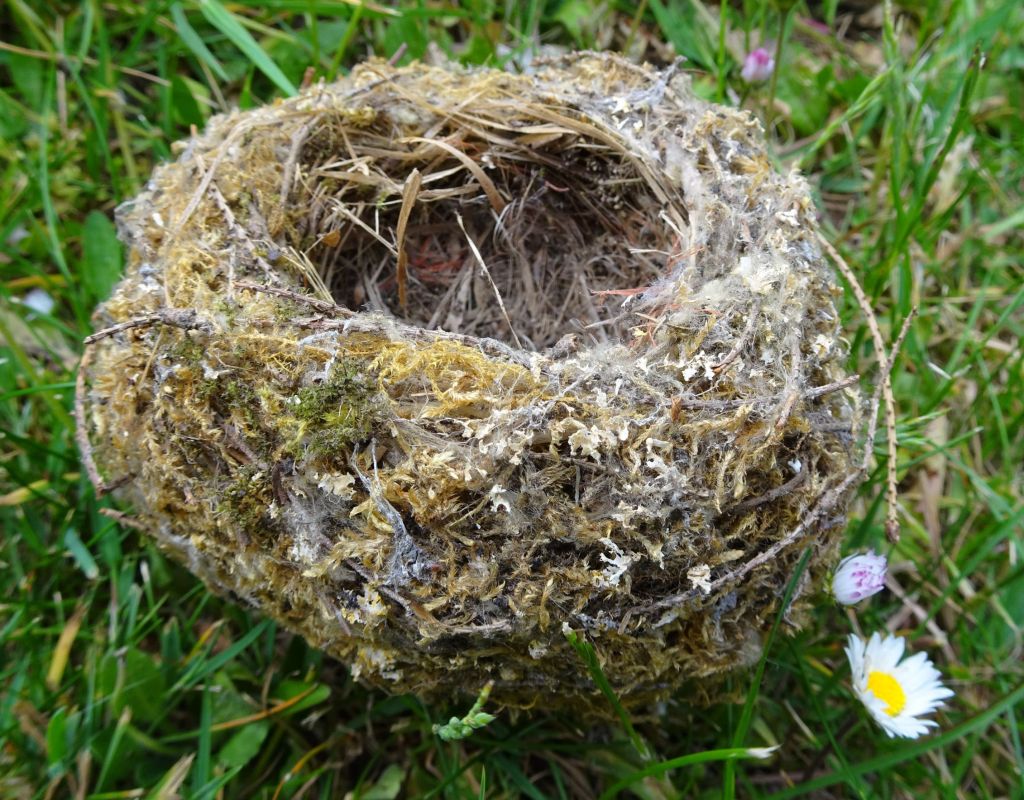
Chaffinches build one of the most beautiful nests of any of our bird species. Often wedged in a fork of a tree and carefully camouflaged on the outside with mosses, lichens and spider webs, the nest becomes almost invisible.

A cosy chaffinch nest decorated with mosses, lichen and spider webs for camouflage. (Taken from a tree last September after the breeding season was well over.)

I was called some years ago by a distressed villager who had been pulling at ivy on a tree and out tumbled a nest and chicks. We tried putting the nest back in the tree but it was too damaged and the adult birds didn’t return… So resist gardening that disturbs vegetation in trees, or scrubby areas until mid-July at least, any cutting back of hedges needs to wait til August.

A tiny shell fragment indicates this nest hatched successfully

Have you found an egg shell lying in the middle of your lawn? As I got this nest out to photograph, I noticed a fragment of shell at its base. If parent birds took the easy option of throwing the egg shells over the side of the nest, predators would be given a clue that a nest was above. Instead, parent birds carry off the shell, and discard it away from the nest. Hence that find of an egg shell in the middle of your lawn – its a good sign – somewhere nearby a nest has safely hatched chicks. So back to the fragment of shell I saw in the chaffinch’s nest. That is the tiny scrap of shell that the chick will have pecked out with its egg tooth, and too small for the parents to carry away and discard. People who monitor nesting success – which provides important information for why a bird species is doing well or not – look for a tiny bits of shell like this in the bottom of a nest – a great sign that the nest hatched successfully. All that singing from the male bird, all the sitting from the female, has resulted in chicks. Hurrah!

Subscribe to my blog.

Enter your email address and click Subscribe to follow this blog.
You’ll get an email each time I add another post.


This work is licensed under a Creative Commons Attribution-ShareAlike 4.0 International License.

Bugles standing witness

I am being fanciful, plants have their own being and place in this world, however finding these small but elegant dark purple flowers standing amongst long grass and glossy buttercups in the churchyard I cannot help but think they are keeping a quiet witness to the lives and deaths amidst which they grow.

Bugles are one of the first wildflowers I learned the latin name of, ajuga reptans, meaning ‘to drive away’ (a hint of its healing properties) and ‘creeping’. I was out surveying a wood with the Beds, Cambs, Northants Wildlife Trust a classic place to find this shady, damp loving plant. Since, I have discovered that they are often planted in shady places in gardens, where not much else will grow. Do you have them in your garden?

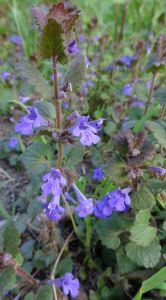
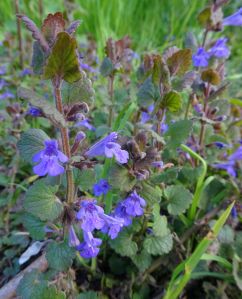
I went out this morning to have another look round St Mary’s churchyard. To my delight I immediately found a patch of ground ivy, germander speedwell – yesterday’s focus blue-purple flowers – growing with bugle, near the new, neatly tended ashes’ burial area.

Once again, I was tripped up thinking, ‘Is that ground ivy, or is it bugle’? At first glance their flowers look similar. Bugle however stands more upright. Bugle’s flowers are packed closer together. Bugle’s flower petals appear to have a touch of yellow, actually that’s the anthers peeping out. The leaves are very different. Ground ivy leaves are scalloped, bugle leaves are gently wavy edged.

Wandering off the main path to the church I found so much more. Left uncut, buttercups, oxeye daisies, red clover – always a good sign of wildlife rich grassland – are all growing. Suddenly I caught my breath. I saw a whole patch of bugle growing, invisible from the path, a startling sign of exquisite nature thriving in what could so easily regarded as unkempt, neglected grass.

I suggest this – and other churchyards with uncut areas – are a great place to have a wander. We will only discover why such areas are important – and a delight – by getting to know what grows in them and watching and listening to the other wildlife that also enjoys them. What we don’t know, we don’t miss. You won’t harm the plants by walking around as long as you take a bit of care where you put your feet. Remember, last year this place would have been cut and these flowers would not have existed…

I’ve been challenged by doing Kelly Holmes’ core session workouts each morning, Nathalie’s encouragement keeps me going. Kelly Holmes keeps saying you can push yourself as hard as you like, but start somewhere… If you haven’t done this before, a bit like I am finding my core (!), you might like to challenge yourself to count all the different species you find, to add to the challenge count the different grasses as well. How about adding the butterflies, hoverflies, bumblebees?

Subscribe to my blog.

Enter your email address and click Subscribe to follow this blog.
You’ll get an email each time I add another post.


This work is licensed under a Creative Commons Attribution-ShareAlike 4.0 International License.

Blue-purple flowers in shady places

From looking upwards at the leaves of trees, I’ve been looking down at my feet, in shady places under trees. So many flower species are blooming now I am going to give you two in one go, one purple, one blue – ground ivy and germander speedwell – and follow that tomorrow with a third, bugle. Each are only a hand span high, if that and at first glance could be confused.

Ground ivy is a common garden ‘weed’, with a propensity to spread rapidly by sending out runners that root. How much time do you spend pulling up this species in your garden?! Its latin name is glechoma hederacea – maybe the sound of that alone ought to lift this species into the ranks of respected garden plants! However, its common names – creeping Charlie, or hedge maids – perhaps keep it down the ranks! Hedera is latin for ‘ivy’, after its ivy-shaped leaves. I hadn’t realised it belonged to the mint family and is aromatic. Next time I find some, I will be giving it a good sniff. Like other mints, it is edible and has been put to all sorts of healing uses over the ages. I’m not about to advise any here but I find it salutary to remember that many of our medicines have origins in plants. Their survival is important to us as well as to themselves and the creatures that depend on them.

Clumps of germander speedwell are like blue hazy mirages alongside shady paths.

I saw clumps of germander speedwell, like blue hazy mirages in the long grass, on the edge of the footpath, that runs left (NE) just after the railway bridge as you go out of the village towards Exning. Possibly speedwells’ habit of growing alongside paths gave these plants the mediaeval name of speeds-you-well – travellers would pin a flower to their coat for luck. Of the speedwells out in flower now, germander speedwell is the most upright, with new flowers coming out above the one that has just ‘gone over’, so forming a spike.

Germander speedwell has stalkless leaves in pairs up the stem.
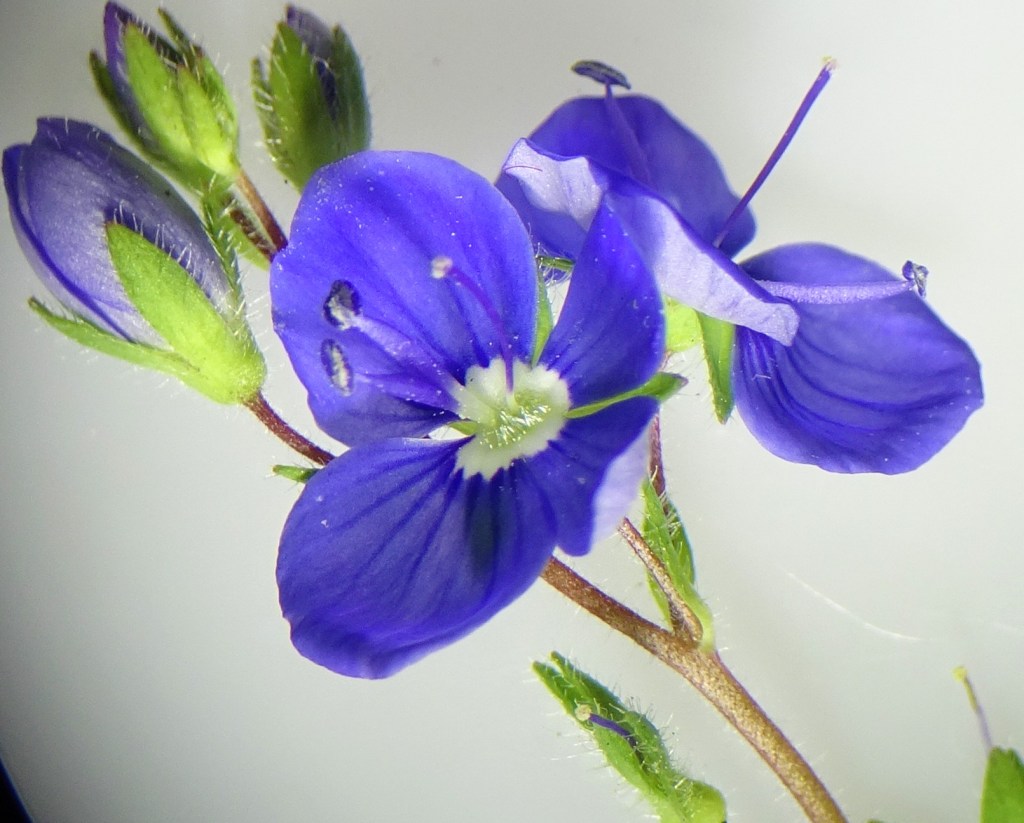
Germander’s four petals are so heavenly blue, in Wales they are called ‘Christ’s eye’.

To distinguish germander from the other speedwells, there are several things to look at. First, note how the leaves are in pairs going up the stem and have no stalk. Second, the flowers are strikingly blue, with a stunning white eye. I’m told that the flower is so heavenly blue, in Wales it is known as Christ’s eye. Now for the clincher. One of the things I love about Germander speedwell is that it has a feature that cannot be confused: its distinctive hairy legs! Only this speedwell has two rows of hairs, one up each side of the stem. Maybe this could become a new Lockdown fashion?!

Germander speedwell has a row of hairs up each side of its stem – a possible new lockdown fashion?

Subscribe to my blog.

Enter your email address and click Subscribe to follow this blog.
You’ll get an email each time I add another post.


This work is licensed under a Creative Commons Attribution-ShareAlike 4.0 International License.



If you go down to the wood today… but which tree is which

I remember when tea leaves came in boxes each with a small picture card, to be collected into sets. One set was of Britain’s trees. Each card had a picture of a tree; from learning the shape of the tree you were supposed to be able to tell the species of the tree. Hmm… I have never found this easy, especially as often our trees don’t have space to grow into their natural shape. So to get their ID sorted I’ve gone for the opposite end of the spectrum – instead of looking at whole trees, I suggest starting with trees’ leaves as they are so distinctive. Leaves are also lovely and fresh at the moment. Just looking at them, I feel better. Yesterday, I took a wander round Priory Wood and gathered leaves from different trees. I’ll focus on three species.

Oak leaves are wavy round the edges

Oak leaves are thin at their base, widening towards their end and wavy round the edges. Oak is one of our longest lived tree species. In the UK, oak is the tree species which supports the most other living creatures. In Priory Wood there is a fantastic old Oak tree, with gnarled, wide girthed trunk and branches.

Hazel leaves are roundish, toothed and hairy, so softish to the touch. If you are not sure if it is hazel, give a leaf a stroke… Once cut, hazel branches grow rapidly and straight upwards from the base of the tree. Hazel used to be coppiced – cut down to the ground – as people used these branches for poles. Our next door neighbour on the allotment off Green Lane still harvests hazel to provide himself – and us – with bean poles. Cutting down of hazel opened up space in woods: as light came in flowers grew and butterflies flew. Where our old woods are being cared for, hazel is once again being coppiced to bring new life back into them.

Each elder leaf has divided into 5 leaflets, each leaflet is evenly toothed round its edge.

Each of elder’s leaves are divided up into 5 leaflets, each leaflet is toothed round the edge. Elder is easy to spot now as its large, flattish, creamy, frothy flower heads are just opening up. We will soon be able to pick elder’s flowers to make delicious elderflower cordial.

When I got home, I had a happy half hour doing a simple version of brass rubbing with the leaves I had picked. I placed a leaf under a piece of A4 paper and with a coloured pencil, held at an angle, I coloured over it. I just love seeing the shape of each leaf and the pattern of their veins emerge. As I did more, I realised that this works best if you have the leaf upside down – this way the most prominent ‘bulge’ of the veins are against the paper you are rubbing onto.

Subscribe to my blog.

Enter your email address and click Subscribe to follow this blog.
You’ll get an email each time I add another post.


This work is licensed under a Creative Commons Attribution-ShareAlike 4.0 International License.
Tree bees buzzing in our nest box

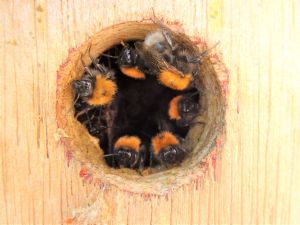
Do you have any occupants in your nest boxes? I put up a house sparrow terrace nest box several years ago. This box has several sections adjacent to each other as sparrows like communal living. Now the box is buzzing – literally. Rimsky-Korsakov in ‘The flight of the bumblebee’, here played by James Galway, captures the energy of the bees as they took up residence here. This section’s entry hole is now circled by guarding bees, who edge aside to allow a bee to fly out or in. From the left hand section of the nest box comes chirping of great tit chicks, their constant demand keeping their parents busy flying in and out. And not a sparrow nest in sight!

Bees featured in my childhood: one of my favourite childhood books was ‘Ant and Bee’; with great excitement I remember spending pocket money on a Single ‘Big Rock Candy Mountain’ which, though not entirely PC, always lifted our spirits, so ideal for this time. However, these did not increase my knowledge much about the real creatures, so I depend on Bumblebee Conservation Trust for my information here.

Bees are not always straightforward to identify. Luckily these ones are! Their ginger thorax, black body (abdomen) and white fluffy rear end (tail) are unique, in the UK at least.

A circle of bees guards the entrance to their nest

Tree bees only arrived in the UK in 2001 from mainland Europe. They have spread widely, often nesting in bird boxes and in lofts. Our box is by our garage door, yet the bees rarely take any notice of us as we clatter around carrying garden forks and spades in and out. Only when after my umpteenth attempt to take a photo of them in their dark hole, and had ‘flashed’ them several times close up did they begin to express a bit of unhappiness with increased buzzing!

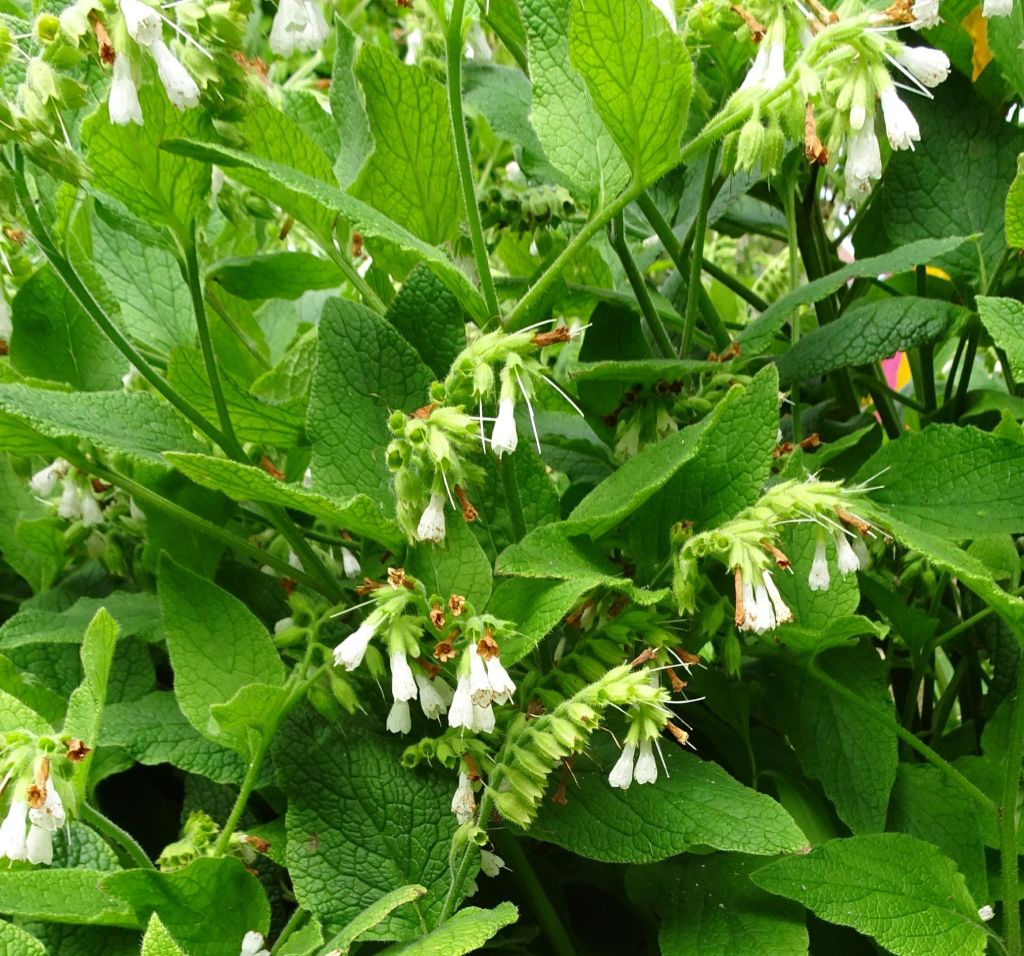
Common comfrey, a favourite flower of tree bees

A queen chooses her nest site in March or April. Six weeks or so later, the larger worker bees go out to forage, while the smaller bees become ‘House bees’. They are excellent pollinators, particularly liking flowers like comfrey which hang downwards. During May and June a lot of bees may be flying around the nest site. These are males waiting for a queen to emerge and hoping to persuade her to mate with them. Male bees have no sting so there is no need to be concerned. If lucky, drones mate. Colonies die out in late July, with drones living independently for a while. Queens that have mated build themselves up, then hibernate for the winter; in spring the process starts again.

My challenge now is to spot these bees as they pollinate flowers – as The Big Rock Candy Mountain plays round and round in my head. I hope that it helps you dance along today too.

If you have tree bees – or species of any sort – you can enter them on irecord and help build up a picture of which species are where across the UK. This information contributes to effective conservation action.

Subscribe to my blog.

Enter your email address and click Subscribe to follow this blog.
You’ll get an email each time I add another post.


This work is licensed under a Creative Commons Attribution-ShareAlike 4.0 International License.

update on chalking

Thank you for your supportive comments about my chalking flower names on pavements. A few times people have seen me as I have been chalking names on Newmarket Road. I’ve asked them what they think. They’ve told me ‘its a good idea’, ‘makes the walk more interesting’, ‘children like it’. This is exactly what I had hoped for.

So I was really disappointed to see that yet again Newmarket Road verges have been cut. The verges look very neat and tidy – I think gradually, imperceptibly, we have become trained to think uniform short cut green is the ideal. Not so long ago we did not have the tools or money to have all this neatness. But this verge – and all the others that have been cut again like this – are ‘dead’. Yet again there are no golden buttercups, or other flowers; bees and butterflies have no food sources, as we walk we have no colours or humming music to lift our spirits; nothing to encourage children to get outside and see what they can see.

In lockdown we are walking more often, and more locally. There is also increasing debate about how we want our world to be post-lockdown. The value of nature around us has become more obvious.

We have choices to make about our world. These choices really matter: For ourselves and for the other ‘life’ that we share this world with. Tina’s windows, a joy as ever, are full of creatures, hedgehogs, bees. Do we want our children only to have these stuffed or crafted versions, as delightful as they are? Or do we want them to see them as they walk round our village – in time, hopefully, on the way to school. Hopefully, in all that word’s meaning.

Pound Hill buttercups

I was delighted to be told there may be a re-think next year about leaving the buttercups to flower on Pound Hill. To let the buttercups flower, will, I think, require a shift in our thinking, to once again enjoying the wavy edges, the longer grass, to recognise again the beauty in the gold of nature. I’d love to know what you think. Scroll to the bottom to the comments box and let me know…

Subscribe to my blog.

Enter your email address and click Subscribe to follow this blog.
You’ll get an email each time I add another post.


This work is licensed under a Creative Commons Attribution-ShareAlike 4.0 International License.

Swifts, swallows and house martins, the sky’s fast fliers

Do you keep a note of the first dates each year that you see a particular bird species? I have often wished that I did, so this year I’ve have made a start. My first swift sighting was 1 May, out along Factory Road. But it wasn’t until last week, as I walked between the Co-op and Costcutters, that I saw heard my first ‘party’ of swifts: they ‘screamed’ overhead, swooping in circles through the sky, their black, precision wings enabling them to turn, dip, angle, at high speed.

Often people ask me how to tell swifts, swallows and house martins apart. All arrive quite late in the spring as they come from the middle to southern Africa. They all swoop through the air, as they feed on insects. They often will come down low to water, as that is where there are a lot of insects.

Swifts are sooty brown but look black against the sky and have stumpy tails.

As we often see these birds only when they are silhouetted against the sky, I look at their different shapes to tell them apart. What they are ‘up to’ and the ‘noise’ they are making – I don’t think these birds have much of a song – is also helpful.

Swifts are sickle shaped and black all over. They fly the highest. They scream! They very rarely sit, except to go to their nest. So if you see birds sitting on a telegraph wire, they won’t be swifts.

Adults have long tail streamers, whiteish body and red under their chin.

Adult swallows have tails with long streamers, juveniles have streamers, but shorter. Even in flight, it is often possible to see their whiteish undersides and catch a glimpse of red under their chins. Their upper body is a beautiful glossy deep blue. Swallows will sit on beams in stables or on telegraph wires and ‘chatter’.

House martins are white underneath, and show a block of white on their upper tail as they sweep past.

House martins are slightly smaller than swallows and have more angular shaped wings – think of a triangle. The white on their upper tail is often clearly visible.

House martins often nest under the eaves around Felsham Chase area

If you see them nesting, that will also give you a clue about which bird you are seeing. House martins, as their name suggests, build their mud nests under the eaves of houses. I’ve noticed in Burwell that they love nesting on houses in the Felsham Chase area, but don’t on what look superficially similar houses up Newmarket Road. Please let me know if you understand why!

Swallows build their mud nests in outbuildings and stables, near to horses and cattle, or water, where there is a good supply of insects to feed their chicks. They don’t seem bothered by people being around – they just get on with what they have to be doing, which is getting food to their demanding chicks! Once we are allowed back to Wicken Fen’s visitor centre area you will be able to see them nesting around the café area, on the beams of the boat shed and sometimes the porch of the cycle hire.

I love seeing tiny chicks’ heads appearing above the mud wall of their nest as their parents arrive to feed them. And just think, the adults have flown all the way from Africa to have their young here in our village. That’s quite something..

Swifts nest in roofs, but under the tiles, so if you are lucky enough to have them, you will hear their chicks, but not see them… more of that anon.

Make silhouettes for your window – you can cut out swift, swallow and house martin shapes out of black paper and stick them to a window. As well as having fun making your own ‘flying bird parties’ this will help stop birds from flying into the window – they are more able to see that there is a pane of glass there.

With thanks to the RSPB community blog for the illustrations.

Subscribe to my blog.

Enter your email address and click Subscribe to follow this blog.
You’ll get an email each time I add another post.


This work is licensed under a Creative Commons Attribution-ShareAlike 4.0 International License.
For this VE day, in lockdown, wild lilies’ delicate beauty

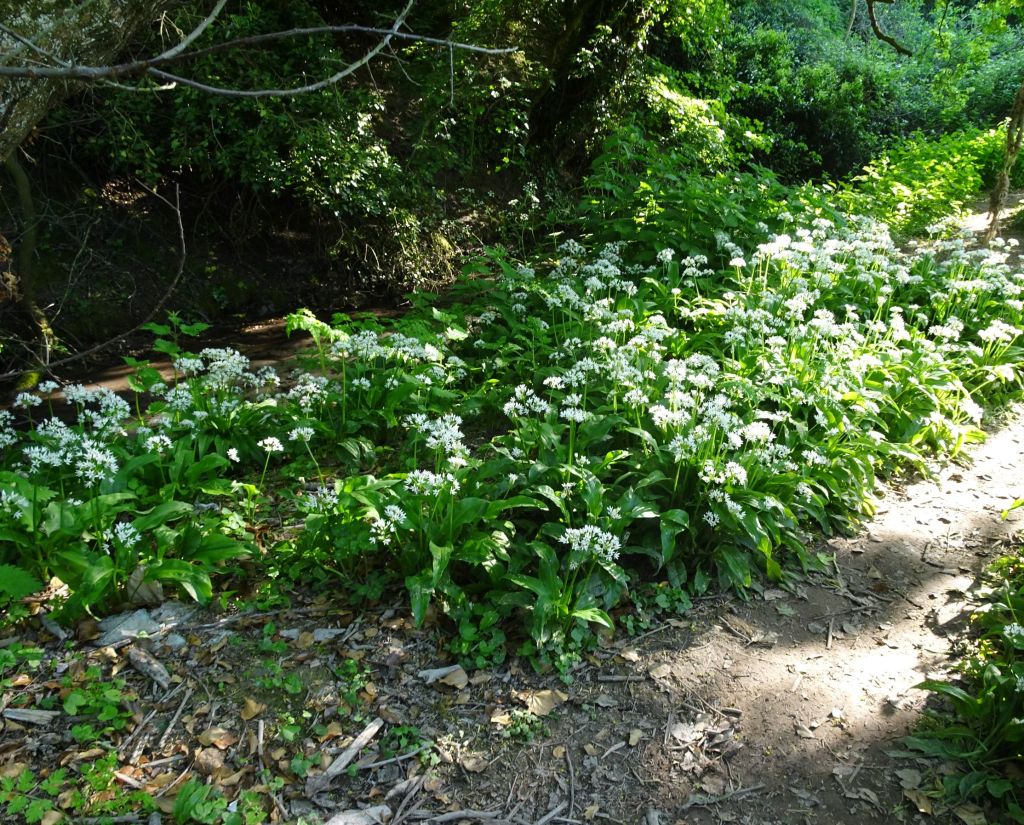
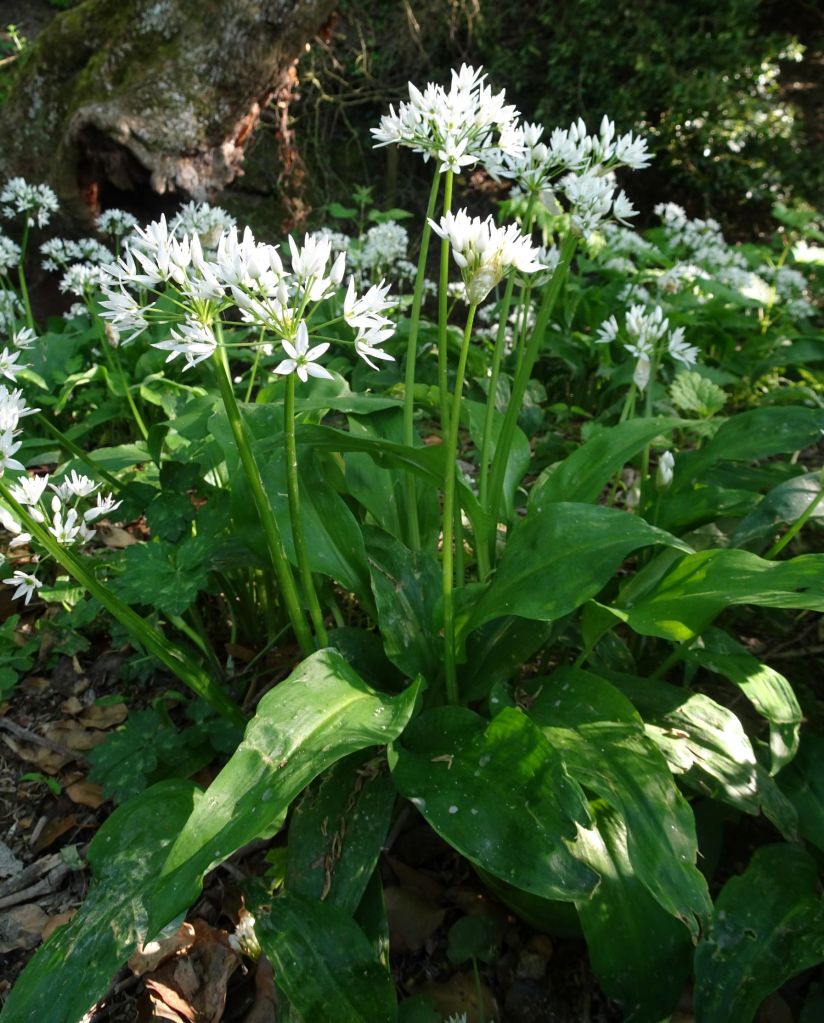
Wild lilies, known as Ramsons or wild garlic, are flowering in the moist, shady areas of Castle Mound. I would of expected such delicate, extravagant flowers to be the product of generations of cultivation – or belong to a more exotic wilderness. Yet they are on our doorstep.

To find them, start where the spring pours out into a sparkling clear pool. Follow the little stream as it curls round. As the ground becomes squishy underfoot, you will see these brilliant white delicate flowers growing alongside the path. Brush their broad, luscious leaves as you walk and the air fills with the smell of garlic.

This Easter we were not able to have in church the traditional display of Easter lilies, beautifully arranged by Pauline Miller, with a list of names next to them to whose remembrance they are dedicated. I remember my grandmother buying lilies for the Methodist chapel in Southery. Even then they were a £1 each. She paid willingly, in respect of those who had died she had loved.

As I remember all those lost, from my family, from our country, from our world, over the years and most recently, these wonderful wild lilies, bring me comfort. The exuberant beauty of each individual flower, of which there are so many on each plant, tells me that each person is remembered and honoured, for their beauty.

Maybe today we could draw our own lily flower, sparkling with the names of those we love who are alive, or who are alive in our memories. I am going to go and do that now.

Subscribe to my blog.

Enter your email address and click Subscribe to follow this blog.
You’ll get an email each time I add another post.


This work is licensed under a Creative Commons Attribution-ShareAlike 4.0 International License.