Hedgehogs in action

Have you recently heard a strange noise coming from outside? At about 10pm last night, we heard persistent grunting, grating, snuffly noises coming from our patio. Was someone sawing wood? I opened the window to see what it was.

Peering through the darkness, I saw two slightly different sized blobs circling each other. As my eyes got accustomed to the dark, I saw they were two hedgehogs! We tried to work out what their noise sounded like. Nathalie suggested carrots being grated, I thought someone unfit running up a steep hill. Mix the two and I think you have it!

with thanks for image to Wikipedia

We needn’t have rushed to look. The hedgehogs kept at their grunting and circling for at least 90 minutes – possibly longer as we went to bed! That’s a lot of carrots grated and hills run up! Just shows we don’t always know what is going on outside our back doors… We hope this means we will have baby hoglets – yes that’s what they are called – in a month or so. As hedgehogs travel 1-2 miles a night, this is not guaranteed.

I have tried to encourage hedgehogs in the garden. If you haven’t already done so, make some piles of logs for insects, and heaps of leaves for cover. There is lots of information about how to encourage and make your garden safe for hedgehogs on the internet. The British Hedgehog Preservation Society, Tiggywinkles wildlife hospital and the RSPCA all have excellent advice and information, including how to build a simple hedgehog home. These can also be bought – a friend of mine was given one for her birthday and to her delight this was used in the first year.
When we had a new fence put up by the fabulous Prospects Trust, based at Snakehall Farm, Reach, we cut a hole in the bottom so that hedgehogs could still travel between our and the next door’s garden and onwards… If your garden fences block hedgehogs from roaming, maybe you could consider cutting some openings.

Now hedgehogs know this hole is for them!

Next how about decorating it? You could use chalk as I have – though paint would be great if you are braver!

While you have the chalks out, why not have a bit more fun? I found doing this very therapeutic…

Banksy eat your heart out…

NB: Costcutters and Tina’s have packets of chalk for sale. Good luck!

And don’t forget these next few weeks to pop your head out of doors in the evenings. You may be lucky and hear grunting…

Subscribe to my blog.

Enter your email address and click Subscribe to follow this blog.
You’ll get an email each time I add another post.


This work is licensed under a Creative Commons Attribution-ShareAlike 4.0 International License.

Blackbird nesting

THE holly bush!

Do you have a blackbird nesting in your garden? I had begun to give up hope for this year, when yesterday morning I heard a rush of footsteps up the stairs and Ian – who was up considerably earlier than me – announced, ‘I’ve just seen a blackbird carrying a leaf into the holly bush!’ This morning the male blackbird was keeping an eye on his territory from a nearby tree as the female continued her nest building.

The knowledge there is this extraordinary, as it were other world, going on within metres of where we are going about our lives is a delight. ‘Within metres’ – perhaps this year I have particular pleasure that these birds are free of the worries of Covid, can just get on with laying their beautiful blue eggs, feed their hungry chicks, without thinking about metres, face masks, lockdown…

Male blackbird watching his territory

Which was the first bird you learned to recognise? I remember the magical moment when I was around six years old, that Marjorie Hill, a family friend, pointed to a bird on her drive in Stapleford and taught me that because it was black, with a bright yellow bill, it was a male blackbird. She then pointed to a same shaped but brown bird, with a muddy coloured bill. I hadn’t noticed before that these birds were different. Now, I could identify a male and female blackbird. This was a revelation and started me out on my love of birds.

In addition, I have now learned how to tell if the male blackbirds in my garden are youngsters (in their first year out of the nest), or adults. All chicks are incredibly vulnerable to being caught by predators while they are in their nest. So they develop as fast as possible, so they can fly away as soon as possible. To achieve this, birds have evolved to compromise on the quality of their first feathers; better to have some that will do the job for the moment, than to be eaten and never even use them. Blackbird chicks fly from their nest the brown colour of adult females – if a bit fluffier and more speckled. Once they have been out of the nest for a couple of months, these young birds then replace their most exposed feathers with ones of adult quality – and so also colour. The result for young male birds is a teenager look – some black and some brown feathers. Do any of the male blackbirds that visit your garden look like this? The blackbird perched in our plum tree does. So I know he was ‘born’ last year and that this is his first go at parenthood. I wish him luck!

(Note: he (and the female blackbird) will change all his feathers after he has finished breeding. Once that is done, he will be in full black plumage and we will no longer be able to tell his age.)

I went to help a primary school in Haverhill run a ‘bird week’. The headteacher told me that when she herself was at primary school, they had all written ‘a bird book’ about a bird of their choice. They had done drawings, found out about their nests, what they ate. Her book was ‘The Blackbird’ and forty years later she still felt a special affinity for them – and had loved birds ever since. This is what she wanted to give her pupils in turn.

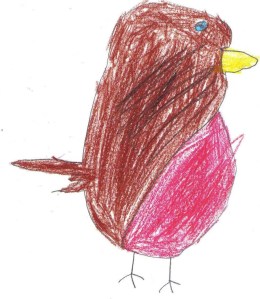
Robin by Megan, aged 7

If you have children at home, how about folding some A4 pages in half to make ‘a book’ and encourage them to draw and write about one of the bird species they see in your garden or street. I’d gladly publish some of the results in this blog. (Send a comment and I will be in touch.)

The British Trust for Ornithology (BTO) runs a Garden Birdwatch scheme, which they have made free during this period. People count how many birds of which species are in their garden for a chosen amount of time a day or week and send this information in to the BTO. We did this and had fun and got to know what was in our gardens and when much better. All the information people send in helps BTO scientists understand what is happening with our commoner bird species and how they use gardens – all of which helps us to know what best to do to keep these birds ‘common’!

Subscribe to my blog.

Enter your email address and click Subscribe to follow this blog.
You’ll get an email each time I add another post.


This work is licensed under a Creative Commons Attribution-ShareAlike 4.0 International License.

Chalking on pavements – illegal activity

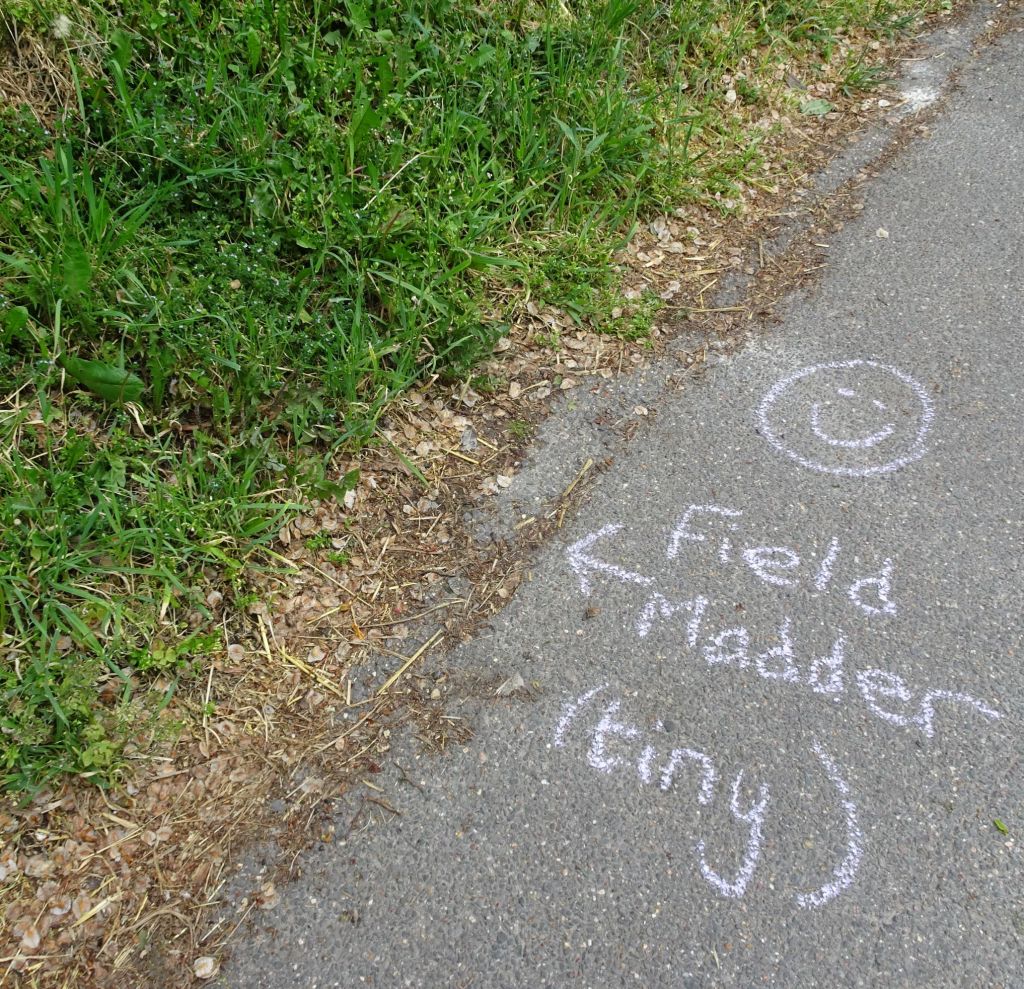
I’ve just done a first – deliberately taken an illegal action. Unknowingly I committed the same offence as a child, chalking hopscotch squares on the pavement as I played with friends. This morning I knew what I was doing. My offence – to chalk names of flowers on the pavement. I have done this to encourage people to notice them, and, if they don’t know their names, to be able to identify them. I also added a smiley face. Partly for the joy of sharing my delight in these flowers with whoever may walk by. Partly as I think we all need a smile at the moment.

First I had to dig to the back of a cupboard to unearth a box of chalks, not used since my girls played schools, writing lessons with chalk on a blackboard. (Chalk, blackboards, school, for several reasons that seems a lifetime ago.) Then I started: purple for the delicate lilac flowers of field madder; yellow for golden buttercups; white for glorious, lavish May.

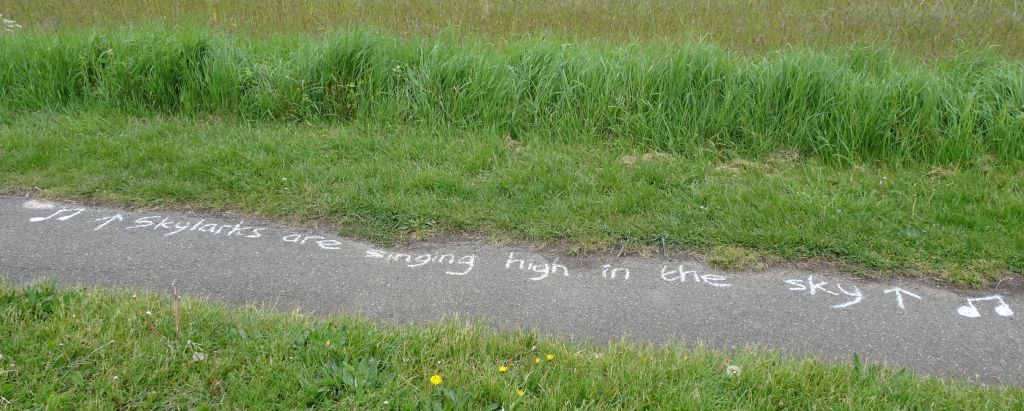
As I wrote, skylarks were singing so I added a suggestion for people to listen for them. I sometimes walk along too wrapped up in my own thoughts to raise my head to listen. Then their song catches my ear. As I listen to these birds singing as they rise, my heart lifts too. I remember too when I did not know the song of skylarks, and I would not have dreamt they could be heard from in our village. They were too ephemeral – birds of poetry and music – to be part of our prosaic world. Yet here they are. Our world is not prosaic at all… That is perhaps above all why I have been out chalking the pavements this morning…

To ‘get your ear in’ to skylark song you can listen here. The British Trust for Ornithology have produced a video which describes skylarks and their song. (This compares skylarks with wood larks. To see and hear woodlarks we will need to wait for when we can visit Thetford Forest again.)

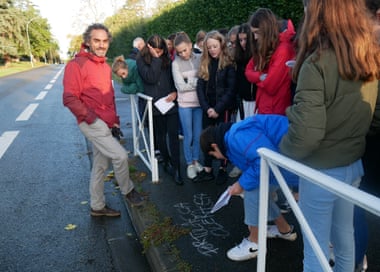
I had been wondering about labelling wild plants round the village when I heard of botanist Boris Presseq of Toulouse Museum of Natural History chalking names on the pavements to highlight street flowers in his city. The simple video of him doing so has had 7 million views. He has understood this moment in time and the desire of people to see and get to know the world that is around them. He said: “I wanted to raise awareness of the presence, knowledge and respect of these wild plants on sidewalks. People who had never taken the time to observe these plants now tell me their view has changed. Schools have contacted me since to work with students on nature in the city.”

Boris Presseq and fellow botanists write chalk plant names on the pavement in Toulouse, France.
Boris Presseq and fellow botanists write chalk plant names on the pavement in Toulouse, France. Note, this is prior to lockdown in France. Photograph: Claire Van Beek/Handout

Dee Carlock, one follower put it very well:

It’s a great idea. When you know the names, the plants become more alive to you as individual beings.

People across Europe have started chalking names of plants on pavements. Sophie Leguil is doing this in Hackney.

Meanwhile, I have come back in, dusted chalk off my hands and am watching the rain come down. I hope a few people will enjoy my efforts and have understood their meaning before they are washed away…

Subscribe to my blog.

Enter your email address and click Subscribe to follow this blog.
You’ll get an email each time I add another post.

It has to be May’s wild lavish blossom

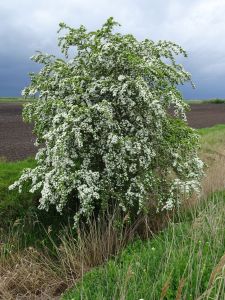
May day and each hawthorn tree, bush, bit of hedging is loaded with ‘May’; masses of white, sometimes pinkish, blossom. As if each tree is sending the message: where one would do, here have several thousand instead.

Hawthorn or May has always been seen as a bringer of hope, of the fertility that comes with spring, of purity. So I am revelling in this plant’s beauty now.

There is a tradition too that Christ’s crown of thorns was made from branches of the Hawthorn tree. From this has arisen a reluctance for people to uproot or damage a Hawthorn tree.

Hawthorns lavish blossom is feeding numerous bees, hoverflies and other insect species. Come the autumn, hawthorns are covered in red berries – haws – providing vital food for thrushes, fieldfares, redwings and if we are lucky waxwings, arriving from the continent for the shelter our slightly warmer winters offer.

Hawthorns are easy to identify at the moment, as they are the only trees covered with white blossom. When not in flower, they can be identified by their leaves’ distinctive shape, and habit of curling their sides slightly upwards. Blackthorn is the other common tree or hedge shrub with thorns. Blackthorns leaves are flatter and don’t have a wavy edge.

Yesterday I cycled along Factory Road. With thunder booming from across the Fen, I took a photo of this lone Hawthorn tree. Since, I have learned of the superstition that such lone trees originate from lightning or thunder bolts and give protection from further strikes… these are trees for this May of all Mays…

Update – buttercups chopped

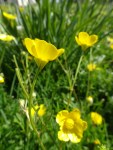
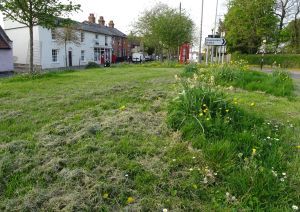
I was devastated to find Pound Hill has been mown again, just as buttercups were covering the grass with their gorgeous golden flowers. The only places the buttercups were saved is where daffodils, non-wild plants, have been planted as the daffodils’ dying leaves have been carefully cut around. The buttercups that happened to be growing amongst them live on…

Buttercups were flowering across Pound Hill
What remains where buttercups were flowering

We have gained so many tools to keep things tidy without much effort. Without realising, our tidiness is destroying something fundamentally precious…

In my first post I mentioned that ‘buttercup’ has been taken out of the Junior Oxford Dictionary. Too few children now use the word to justify it having a place. Concern at the loss of words such as this was so great that fundraising campaigns bought every primary school a copy of Robert Macfarlane and Jackie Morris’s ‘Lost Words’. This book celebrates nature such as ‘buttercups’, ‘acorns’, and ‘otter’ that are being lost from children’s vocabulary – and worlds. How ironic people raised money to get this book into primary schools, while money continues to be spent cutting down the flowers we are so concerned children no longer know the name of.

I hope we have a rethink about how we want our world to be…

Wild clary – beauty on the verge

Blue-purple spikes of wild clary on the verge by the doctor’s surgery

Yesterday I went to post a letter. In these abnormal times this has become news! To my delight I found wild clary’s long spikes of deep blue-purple along the verge by the doctor’s surgery. I’m sure last time I looked they were not there. Maybe the rain has helped them shoot up.

Wild clary is a salvia. I am tending a couple of salvias in my garden, yet here they are growing wild for all to delight in. Reading up I’m told their wrinkled, toothed leaves have a faint sage scent. Next time I am passing I will give one a rub. Something outside the house that is safe to touch…

Wild clary’s wrinkled, toothed leaves and square stem
and deep blue-purple, two lipped flowers

Holly blues on the wing

Holly Blues have been flitting across our gardens throughout this month. We have three main blue butterflies in the south of England: holly, common and chalkhill blues. I used to feel unsure about which was which – all were quite small, all dashed about and all looked much the same! Actually, telling if it is a holly blue is quite easy.

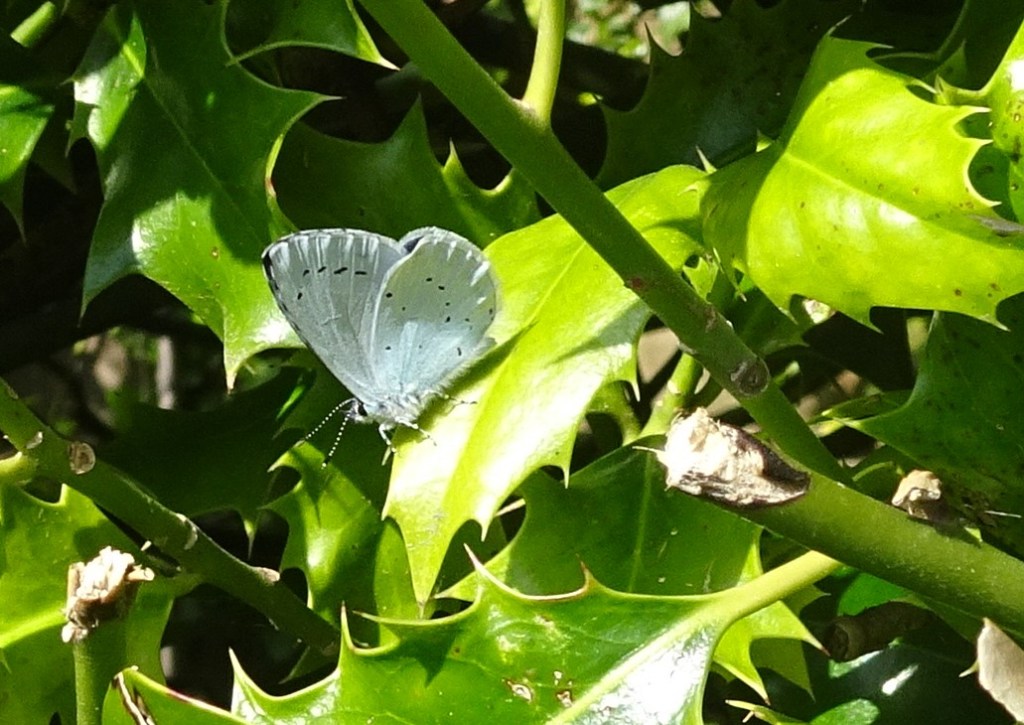
Holly Blue showing the distinctive light blue colour of its underwings

For a start, only holly blues have been flying this last month, so if you have seen a blue butterfly it will almost certainly have been a holly blue. Also, only holly blues have light blue underwings. Common and chalkhill blue butterflies’ underwings are a light brown. As holly blue butterflies often rest with their wings folded, this is a really useful feature for ID.

In addition holly blues have a chequered black and white pattern to their wing edge. Common blues’ wing edge is plain white.

Holly blues have a chequered white and black edge to their wings.

Common blues will start flying soon so we will soon be able to have fun spotting which is which. Good luck!

St Mark’s flies are flying

Have you been assailed by clouds of black flies recently? I was introduced to St Mark’s flies two years ago in early May. I was walking near Mundford with a brilliant local naturalist, Ian Simper. Around us bird cherry trees were dripping with white blossom flowers. I noticed a large number of glossy black flies, with a distinctive longish body flying to and from the flowers and landing on our clothes. Ian told me they were St Mark’s flies, named as they emerge close to St Mark’s day, April 25th. I was delighted to see St Mark’s flies yesterday, April 27th, as I walked along a hawthorn hedgerow, near Burwell Lode.

A St Mark’s Fly on Bird cherry leaf, with blossom behind

These flies don’t get much of an adult life, only flying for around one week. Most of their life is spend as larvae, where they munch on rotten vegetation with their strong jaws.

St Mark’s flies are a distinctive glossy black, with long dangly legs.

I don’t know of any music or poems written about these flies(!) yet they are extraordinary. The males’ have large eyes which are divided by a groove. The upper and lower parts of each eye send separate signals to their brain. The male is therefore able to keep a lookout for a female with their upper eyeparts – an urgent task with only a week to mate(!) – while with their lower eyeparts they are able to assess their distance from the ground, enabling them to hover. (Information from Buglife’s website: https://www.buglife.org.uk/bugs/bug-directory/st-marks-fly/.)

As they feed on nectar, these flies are important pollinators of fruit trees and crops.

As we get tidier and tidier in our gardens and out onto our verges, creatures like St Mark’s flies have fewer places to spend their time as larvae or to get protection from the cold in the winter months. Leave piles of rotting leaves in corners of your garden. Add bits of wood, anything that can provide shelter and food. Or make bug hotels out of scraps of materials, your construction can be as grand, random or quirky as you like. Buglife has some great ideas to get you started: https://cdn.buglife.org.uk/2019/07/Build-a-bug-hotel.pdf. You will be giving creatures like these St Mark’s flies, which are amazing for themselves and play such an important part in our ecosystem, a place to thrive.

Update: love of dandelions

Pat Richards, my mother-in-law, told me her grandfather, who lived in Abertillery, South Wales, loved dandelions and used to say that if people didnt think of them as weeds they would be cultivated. By showing you their beauty, and understanding how they feed other wildlife, this is just the change in thinking that I hope to achieve.

How about we allow a few to grow, where we can?

Update: Cuckoo poem

Cuckoo. Chris Romeiks.

Following on from my post about Cuckoos, Malcolm Creese – the person who directed me to Delius – sent me a Japanese haiku poem that he wrote about the Cuckoo. This was highly commended in an international competition. I love it…

With only two notes               

the cuckoo says more than the      

blackbird ever can                    

たった二言で

カッコウは

ツグミより多くの歌を

Malcolm says, the idea is that some people talk an awful lot but don’t say much, and others can speak two or three words and it means much more.

For more of the entries see https://akitahaiku.com/2010/12/03/the-results-of-the-12th-hia-haiku-contest-2010-3/