Blue-purple spikes of wild clary on the verge by the doctor’s surgery
Yesterday I went to post a letter. In these abnormal times this has become news! To my delight I found wild clary’s long spikes of deep blue-purple along the verge by the doctor’s surgery. I’m sure last time I looked they were not there. Maybe the rain has helped them shoot up.
Wild clary is a salvia. I am tending a couple of salvias in my garden, yet here they are growing wild for all to delight in. Reading up I’m told their wrinkled, toothed leaves have a faint sage scent. Next time I am passing I will give one a rub. Something outside the house that is safe to touch…
Wild clary’s wrinkled, toothed leaves and square stem
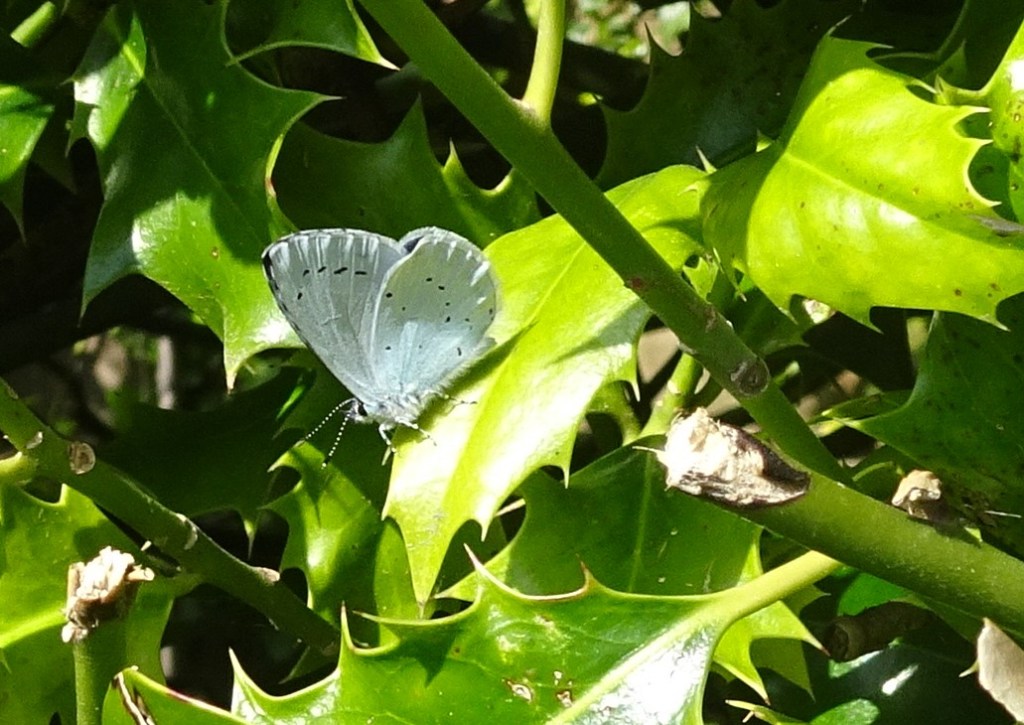
Holly Blues have been flitting across our gardens throughout this month. We have three main blue butterflies in the south of England: holly, common and chalkhill blues. I used to feel unsure about which was which – all were quite small, all dashed about and all looked much the same! Actually, telling if it is a holly blue is quite easy.
Holly Blue showing the distinctive light blue colour of its underwings
For a start, only holly blues have been flying this last month, so if you have seen a blue butterfly it will almost certainly have been a holly blue. Also, only holly blues have light blue underwings. Common and chalkhill blue butterflies’ underwings are a light brown. As holly blue butterflies often rest with their wings folded, this is a really useful feature for ID.
In addition holly blues have a chequered black and white pattern to their wing edge. Common blues’ wing edge is plain white.
Holly blues have a chequered white and black edge to their wings.
Common blues will start flying soon so we will soon be able to have fun spotting which is which. Good luck!
Pat Richards, my mother-in-law, told me her grandfather, who lived in Abertillery, South Wales, loved dandelions and used to say that if people didnt think of them as weeds they would be cultivated. By showing you their beauty, and understanding how they feed other wildlife, this is just the change in thinking that I hope to achieve.
Following on from my post about Cuckoos, Malcolm Creese – the person who directed me to Delius – sent me a Japanese haiku poem that he wrote about the Cuckoo. This was highly commended in an international competition. I love it…
With only two notes
the cuckoo says more than the
blackbird ever can
たった二言で
カッコウは
ツグミより多くの歌を
Malcolm says, the idea is that some people talk an awful lot but don’t say much, and others can speak two or three words and it means much more.
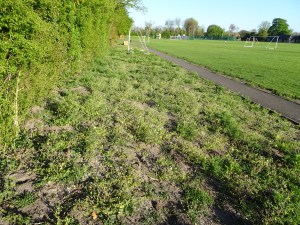
Yesterday I found a gem of an area for wild flowers. I was walking (I should have been jogging!) round the trim track at the Recreation Ground. Along the north-east edge – the long side that runs on from the skate park – is a bareish length of chalky ground. At first glance this area looks a bit of a mess and lacking in growth – especially compared to the lush green of the Rec’s grass. But this is just the sort of area where wild flowers have a chance to grow.
The chalky patch of bareish ground between the trim track and the hedge is full of wild flower plants
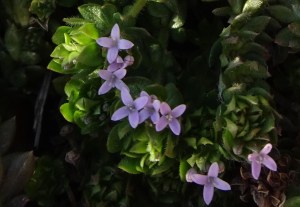
As I looked closer I spotted big clumps of Field Madder. I use ‘big’ advisedly, for this is a low-growing, creeping plant with tiny leaves and even tinier flowers. But once you have spotted the flowers, you see more and more.
Pinky-purple field madder flowers, my thumb gives an idea of their tiny size
Field madder used to be common in arable fields, but is now much less frequent because of arable intensification. This patch of what looks like wasteland, gives gems such as this beautiful small plant a place to thrive.
What has happened here is that seeds of wild flowers which have sat in the soil for years – in the ‘seed bank’ – have suddenly been given the right conditions to grow – a bit of disturbance, and space – they are not competing with the vigorous grass, or nettles or thistles. The plant species growing here are ones that love chalk, and so are similar to the special flora of the chalky Devil’s Dyke. We need to keep watching this area, as who knows what special species will appear.
I counted the number of different species in a small patch of this area and compared this with the number of species in the same size patch of lush green grass. The bareish patch won hands down. Soon it will be dazzling with all sorts of wild flowers in bloom, which in turn will provide a feast for butterflies, bees, hoverflies.. and our eyes.
To really appreciate how special this area, have a go yourself at counting the number of species in a small area of this edge, and contrast the total with the number in the same sized area of the adjacent grassland. If you have children, take huulahoops or a skipping rope, to mark out an area to count. You don’t need to be able to identify the species. The difference in leaf shapes will enable you to tell and so count different species.
Look out for similar bareish patches as you walk round the village. These are where wild plants get a chance to grow. In particular, I’d love to know if you see field madder elsewhere.
I heard my first cuckoo last week, walking out by the Anchor pub. Have you had the chance to hear one yet? In the days when people didn’t have diaries or smart phone calendars, hearing the first cuckoo call would have been like the radio announcement ‘the clocks go forward this weekend’ – after the dark days of winter, spring is here!
While a cuckoo’s call is distinctive, and travels a long way, seeing a cuckoo is much harder. William Wordsworth describes how elusive they are to see:
List ’twas the cuckoo O, with what delight Heard I that voice! and catch it now, though faint, Far off and faint, and melting into air, Yet not to be mistaken. Hark again! Those louder cries give notice that the bird, Although invisible as Echo’s self, Is wheeling hitherward…’
The number of plants named after cuckoos reflect how widespread and abundant cuckoos once were – I wrote about cuckoo-pints yesterday, for example. The late Geoff Parr, who lived round the corner from us, told me cuckoos used to be regularly heard in Burwell. That was when there were orchards throughout the village, providing additional income for farm labourers, who sent the fruit on the train from Burwell into London. My mother, who lived in Southery, said ‘there were so many cuckoos you didn’t take any notice.’ Now to hear one we need to be walking on the edges of the village, to hear ‘Cuckoo, Cuckoo’ calling across the Fen.
There are also numerous rhymes and folk-lore related to cuckoos. As I passed – at a good distance – a family group, we shared our delight at hearing a cuckoo. They said that they should have had cash in their pockets – explaining that in Bulgaria where they were from, having cash in your pocket when you hear a cuckoo brings luck. I’d be glad if you’d let me know if you know of more traditions like that.
The rhyme below gives a clue to Cuckoos’ unusual approach to bringing up their young – they get other birds to do the work, leaving themselves free to fly off to Africa in July!
The cuckoo comes in April, He sings his song in May, In the middle of June he changes his tune, In July he flies away.
Cuckoo egg in a reed warbler’s nest at Wicken Fen, copyright Richard Nicoll.
As I am sure you will know, cuckoos lay their eggs in other bird species’ nests.The cuckoo chick hatches and evicts the eggs and/or chicks of the host bird. The cuckoo chick then calls at a sufficient rate to mimic that of the four or so chicks the parent birds were expecting to have. This makes sure that its host parents feed the cuckoo chick at the rate it needs.
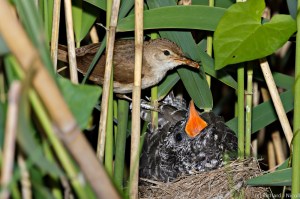
Reed warbler feeds a cuckoo chick, Wicken Fen. Copyright Richard Nicoll.
While the host birds can be very suspicious of an unusual egg, once the chick has hatched, they are far too committed to bringing up any chicks in their nest that they fail to notice that the cuckoo chick rapidly becomes grotesquely larger than their own chicks would have been – and than themselves. As a seven year old, I remember watching a robin sitting on the back of a fledged cuckoo chick, feeding worms into its demanding mouth.
Nick Davies has extensively studied cuckoos at Wicken Fen. His book ‘Cuckoo, Cheating by Nature’ (2015) is a fabulous read, giving an insight into how the host birds – here mostly reed warblers – try and protect themselves from the parasitic cuckoos, and the strategies cuckoos use to fight back. https://www.bloomsbury.com/uk/cuckoo-9781408856567/ Nick Davies is brilliantly describing what is happening on our very doorstep!
“This amazing detective story by one of the country’s greatest field naturalists is also a fascinating study that solves many of the puzzles surrounding this most extraordinary bird” – Sir David Attenborough
The number of cuckoos in the UK has halved in the last twenty years. To help understand the causes of their decline, the BTO has satellite tagged some cuckoos and followed their journeys . We are able to watch ‘live’ as these cuckoos travel to the UK from their wintering base in the Congo basin.https://www.bto.org/our-science/projects/cuckoo-tracking-project. The birds are named and watching their journey can become addictive. Here is the latest news of Cuckoo Carlton II:
Carlton II didn’t linger for long at the Burnham Beeches Golf Club, by 3pm yesterday afternoon he was passing Bungay in Suffolk and by 530pm he was close to Great Yarmouth. The last updates received early this morning show him just a few miles north-west of his breeding and tagging site at Suffolk Wildlife Trust’s Carlton Marshes nature reserve and close to the village of St Olaves. This completes Carlton II’s migration which covered a distance of approximately 16,700 km (10,377 miles) from Suffolk to Gabon and back again.
For a bit of mathematical fun, how about working out how many laps of your garden/ trips to Lanes bakery/ journeys to school/work it would take for you to have done Carlton’s mileage. Then work out how long it would take you, and compare with how long it has taken Carlton. These birds are phenomenal!
Nick Davies can mimic cuckoos by calling ‘Cuckoo’ into his alternately cupped and open hands. Have a go. I’ve just been trying myself and have heard my daughter Nathalie saying to Ian, my husband in the next room ‘she’s gone Cuckoo…’.
Leaves and flower of a cuckoo-pint. The leaves are arrow shaped.
A poke about in a shady wild spot, or in a your garden may reveal this striking plant which has just started to flower. A member of the Arum or Lily family, Cuckoo-pints make look innocuous. They are actually clever traps, inveigling in unwitting flies with a meaty smell (not nice) and warmth, then preventing them from leaving with slippery slopes and spiky protuberances.
Only once the flies have pollinated the female flowers, does the outside structure shrivel and release the flies. The flies, now covered with pollen from the male flowers in the structure, then get tempted into another cuckoo-pint flower and the process starts all over again. Who would have thought all this was going on in quiet Burwell lanes?
Yesterday, I found cuckoo-pints in this shady byway opposite Meadowlands
I found Cuckoo-pints in flower yesterday, just after I heard my first cuckoo calling across the Fen. This plant has a number of names, either, like cuckoo-pint, after its flowering with the arrival of cuckoos, or those like lords-and-ladies or Adam-and-Eve after its phallic shape and combination of male and female flowers down the inner ‘spike’, (the spadix).
I have known this plant for a long time. Today is the first time I’ve taken a look inside – I unwrapped the leaf, which is actually the plant’s equivalent of a petal, which protects the flowering sexual parts. Inside I caught my breath when I found this complex structure.
Inside a cuckoo-pint – an elaborate structure designed to ensure pollination
Fertile female flowers are at the bottom of the structure, (to the left in this photo) these open first. As they open, the flower head releases a strong smell and heat, attracting in small flies. The flies are trapped inside, sliding down the smooth inner surfaces, unable to get out until they have pollinated the flowers. Next to the female flowers are the male flowers – actually lots of tiny flowers making up the ball of brown. Each of these tiny male flowers splits to release pollen. Above this ‘ball’ are the infertile male flowers, which are prickly spikes, which help keep flies trapped inside.
Flowering parts of Cuckoo-pints, illustration from Common Families of Flowering Plants, Michael Hickey and Clive King
The female flowers develop into a head of bright red berries. These are poisonous – indeed much of the plant can cause an allergic reaction if the juices get on the skin.
However, I’d still advocate taking a close look at one of these flowers – they are extraordinary. Carefully roll back the outer circling leaves and look inside. Have a whiff and see if you would be attracted in, like the flies!
Play count the pints and see how many you can find. If each will have about 30 berries how many plants will that be to grow?
After leaving the flower in the sun in the kitchen, I saw that the male flowers had split and grains of pollen were pouring out. Extraordinary. If you have one of these plants in the garden, this is another to look at through a magnifying glass, or take close up photos – like a look into another world.
Pollen pours out of the split sides of the male flowers
Have you seen an orange-tip flutter across your garden or along a hedgerow yet? Orange-tips are an early spring butterfly that emerge after being in a chrysalis for 10 to 12 months. Males emerge first and are the ones with the bright orange tips to their wings. This bright splash of colour is thought to warn predators that they are nasty to eat – as well as attract the females. For us, the orange makes them easy to identify – and to remember their name! Two wins in one…
Orange-tip male feeding on a daisy in an uncut patch of lawn
Females are less showy creatures – as in so much of nature. White on top, their underwings, as with the males, are dappled light green, which provides a brilliant camouflage. Seeing their dappled underwing is the best way of distinguishing an orange-tip female from other species of white butterflies.
I had the good fortune to spot a female orange-tip just after she had emerged from her chrysalis. She spent several hours drying her wings, sitting on an aquilegia plant at the front of our house.
Newly emerged female orange-tip drying her wings, ready to fly
In our gardens, orange-tips lay their eggs on honesty and garlic mustard, known more familiarly as ‘jack-in-the-hedge’ plants. Keeping some of these plants in our gardens gives us a better chance of seeing them.
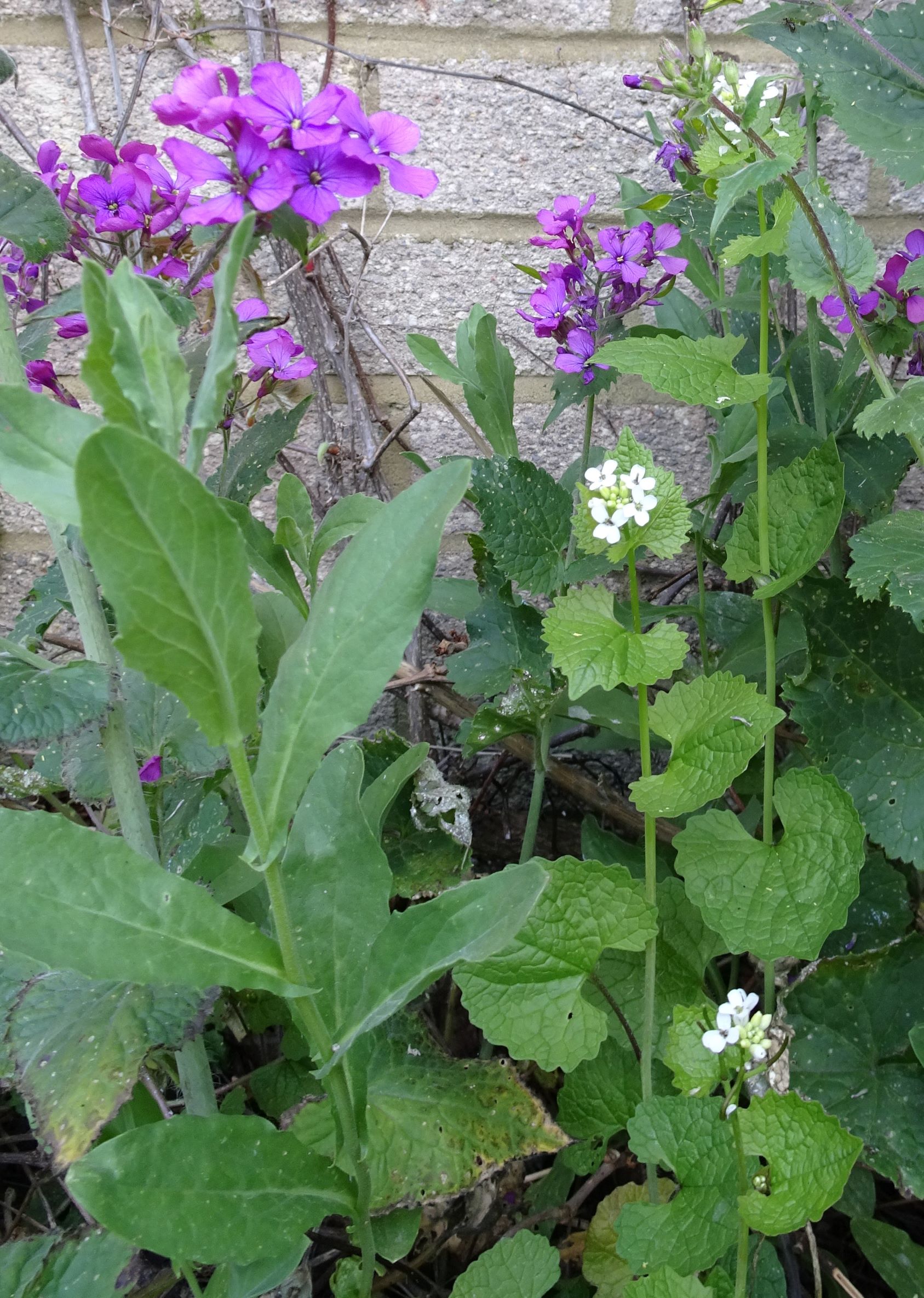
Honesty plants, with their purple flowers and garlic mustard, with white four petalled flowers and leaves that smell of garlic when you rub them, are favourite egg laying sites for orange-tips and provide food for their hungry caterpillars.
Butterflies are great fun to paint. Cut out a butterfly shape – two large upper wings, two slighter small lower wings and a long thin body down the middle. Fold the paper in half along the long body. Open the paper out and splash some bright paint on one wing. Fold the paper in half again, along the crease you made, so that some of the paint transfers onto the other wing too. Open the paper back out and you have a symmetrically coloured butterfly. If you have pipe cleaners you could stick these on for antennae. Stick them to a front window with blu tac to cheer everyone who passes. Or turn them into a butterfly mobile to flutter in your room.
I wonder if you blew dandelion clocks as a child to tell the time? I remember loving the idea that by blowing I had the power to tell the time. Dandelions are in flower now all round Burwell. While I hear gardeners (my husband!) and people at the allotment (my husband again!) bemoaning their spread, I’ve been taking a closer look.
I’ve been discovering the wonder of dandelions’ structure; the joy of a watching a bee revel in their pollen, buzzing as if with the pleasure of a purring cat; while my neighbour has been picking their leaves for salad and to stir fry. Like small suns fallen to earth, these plants are made to make us smile.
Dandelion means ‘lion’s teeth’, possibly named for their jagged leaves or the tooth-like bracts that stick out, surrounding the flower.
‘Dandelion’ comes from the French ‘dent-de-lion’, a translation from mediaeval latin ‘dens leonis’ meaning ‘lion’s teeth. Some think this name comes from the jagged edges of the leaves. I think the name is more likely to come from the sharp tooth-like shape of the leaves (the bracts) that surround the flower, that point outwards as if daring anyone to come close.
Last year I went on a workshop to learn to identify dandelions. How many species of dandelion would you guess are in the UK? I was astonished to learn there are 235. One to remember for a pub quiz – virtual or once we get out of Lockdown! Encouraged to look closer, I discovered different shapes and colours to their leaves, that their bracts have many different shapes, lengths, and colours, and that their seeds are again different colours and shapes. ‘Dandelions’ are much more complicated than they appear! I also learned April is the main month they are in flower – so now is the time to enjoy them.
I love dandelion clocks – and not just to blow. They are superlatively formed structures, designed to maximise the spread of their seeds by the wind – or a child’s puff.
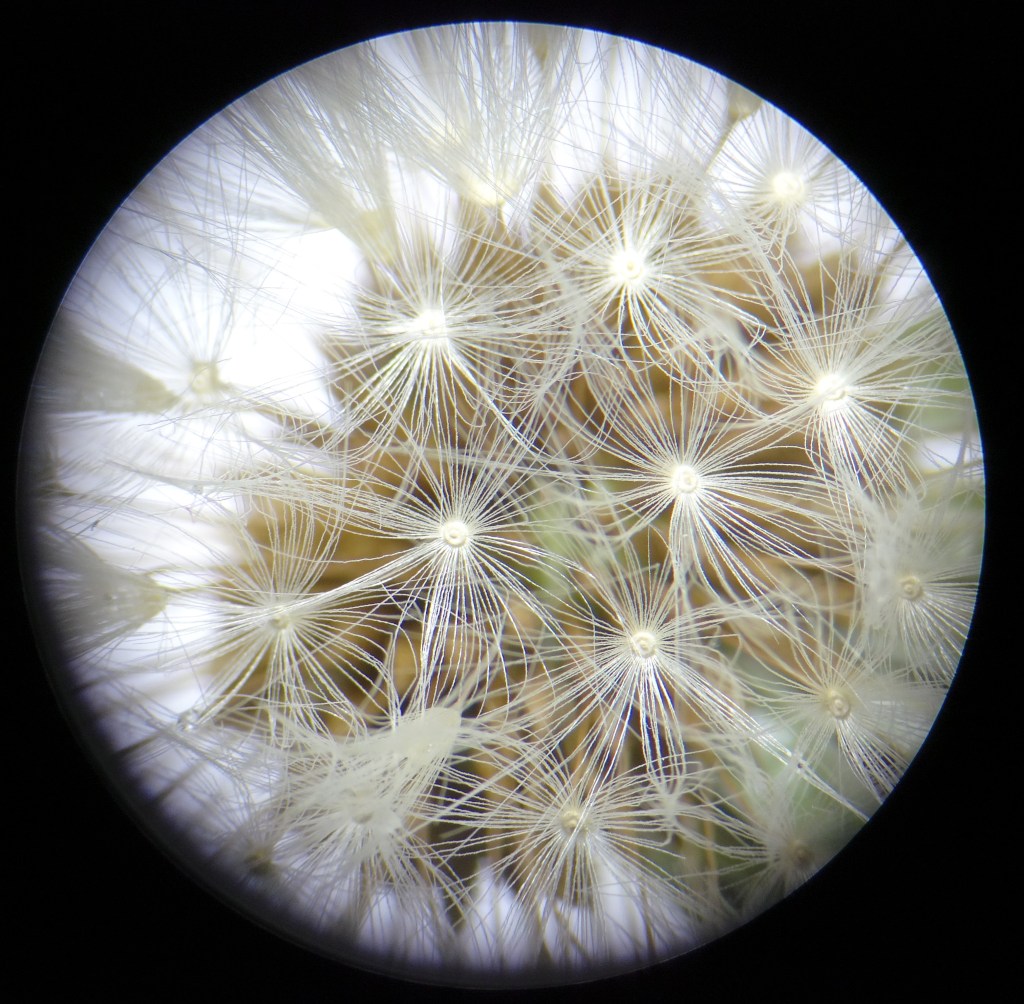
Exquisite circular structure of a dandelion seed head, seen through a microscope
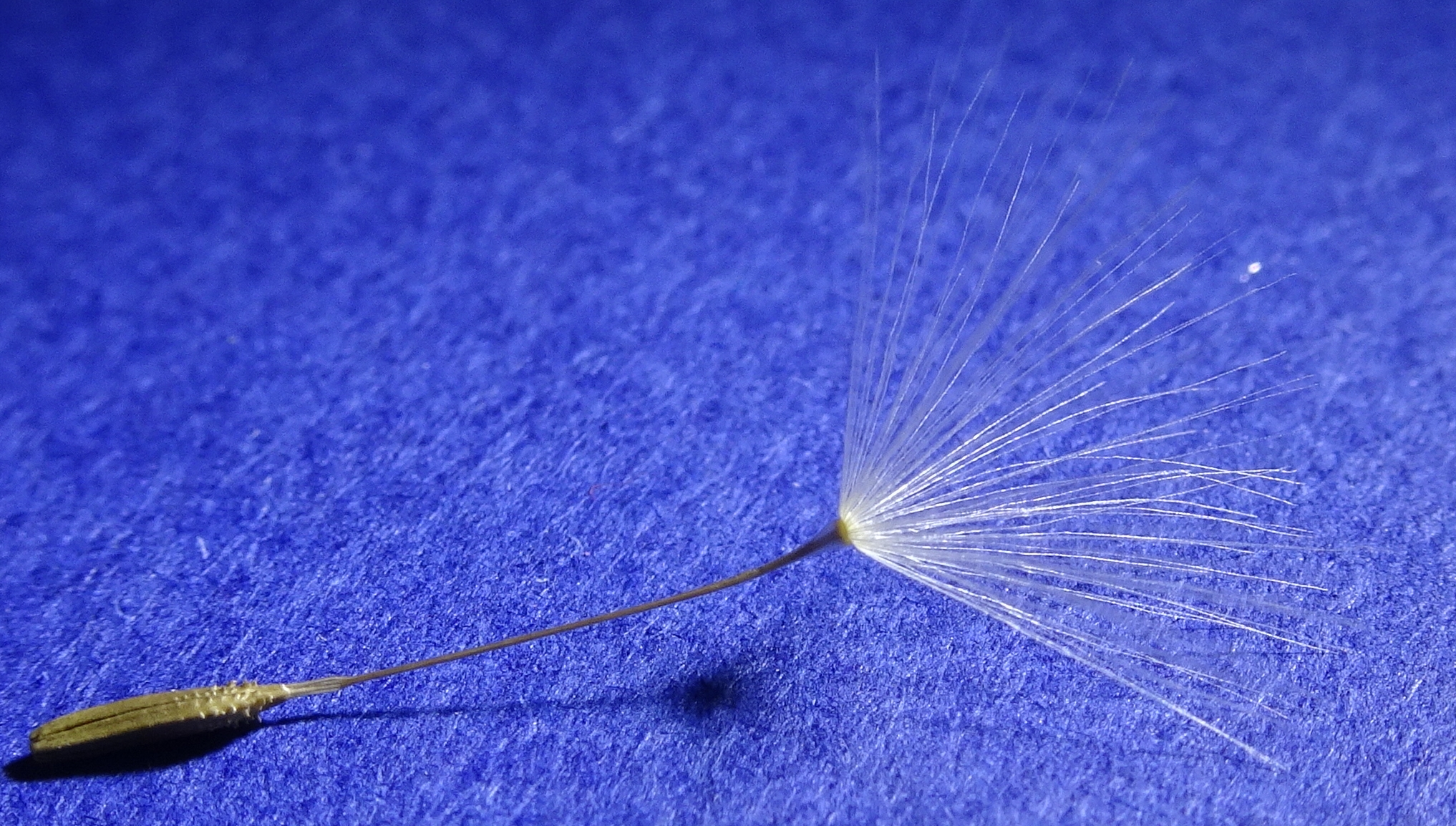
Single seed with its ‘parachute’ of silky hairs
If you have a magnifying glass (one with a light is even better, my Mum uses one to help with reading) use it to have a close up look at a dandelion clock yourself. If you have a smart phone, you may be able to take a magnified photo of part of a dandelion clock. Or take close ups of several different plants for a ‘guess which plant this comes from’ section of your next virtual quiz.
Or just pick a clock, puff and let the seeds fly…
A different way of thinking
After reading this post, Pat Richards, my mother-in-law, told me her grandfather, who lived in Abertillery, South Wales, loved dandelions and used to say that if people didnt think of them as weeds they would be cultivated. By showing you their beauty, and understanding how they feed other wildlife, this is just the change in thinking that I hope to achieve. How about we allow a few to grow, where we can?
Children love to play the game of picking a buttercup, then putting the flower under someone’s chin. When the chin glows yellow, to their delight they have ‘proved’ the person likes butter. Yet the Oxford Junior Dictionary has taken buttercup out of its dictionary. The word is no longer used often enough by children to merit inclusion. Buttercups are out all round our village, so now’s the time to look out for and enjoy them again.
The buttercups growing throughout the village are treasures, with their glowing colour, glossy petals and abundance and are also much loved by insects for all the pollen they provide. There are three commonish species of buttercup: creeping, bulbous and meadow. We are lucky to have the more unusual bulbous buttercups growing in our grassy areas around Burwell.
You can tell one buttercup species from another by their different leaf shape , however its really easy to tell bulbous buttercups as their underneath petals, officially called sepals, fold backwards down their stems. As you walk round the village, take a quick look.
Bulbous buttercup growing on Newmarket Road, with sepals folded downwards below the petals and fine cut leaves.
If you are with children why not let them pick a small bunch, while leaving some for others and the insects to enjoy. For a long while there has been a strict rule about not picking wild flowers. This has led to people no longer taking much notice of them or enjoying them. Buttercups are sufficiently common for picking them not to cause a problem and the plants will flower again after being picked.
Try pressing buttercup flowers – I first gained my love of flowers from pressing them. Pick some buttercups, lay them between a few layers of newspaper, put some cardboard either side and weight this ‘sandwich’ down with a few books. After a few days you can glue them into a ‘flower book’ or use them to make a card for someone who needs a bit of cheer.













 Nature to look out for in Burwell